
By Lisa Schreiber
With just a couple of weeks until the midterm elections, political advertising and campaign coverage are intensifying, bringing political uncertainty back into investors’ focus. With control of Congress up for grabs, the results could influence fiscal policy, regulation, taxes, and government spending, all with potential implications for financial markets. Yet while election headlines can fuel short-term volatility, history suggests the relationship between midterm elections and market performance is more nuanced than the political rhetoric might suggest. For investors, the key is to look beyond the headlines and maintain a long-term perspective amid the uncertainty.
Where things stand today:
– Narrow Republican majorities: Republicans currently control both the House of Representatives with a 218-214 (1 Independent, 2 Vacancies) majority, and the Senate with a 53-45 (2 independent) split1
– A competitive election: All 435 House seats and 35 Senate seats are up for election, including 13 Democratic-held and 22 Republican-held Senate seats1
– Democrats favored in prediction markets: Prediction markets such as Polymarket and Kalshi, along with broader polling trends2, currently favor Democrats to win seats with a probability of about 90%3 for the House and 64%4 for the Senate
Historically, the president’s party tends to lose ground in midterm elections, losing an average of 25.7 House seats and 3.6 Senate seats. Given the narrow margins in Congress, a shift in control of either chamber could result in a divided government, potentially increasing the likelihood of legislative gridlock over the next two years.5
Midterm election years have historically been more volatile than non-election years. As the chart below illustrates,6 the S&P 500 has typically lagged in the months leading up to Election Day before recovering once the election has passed.
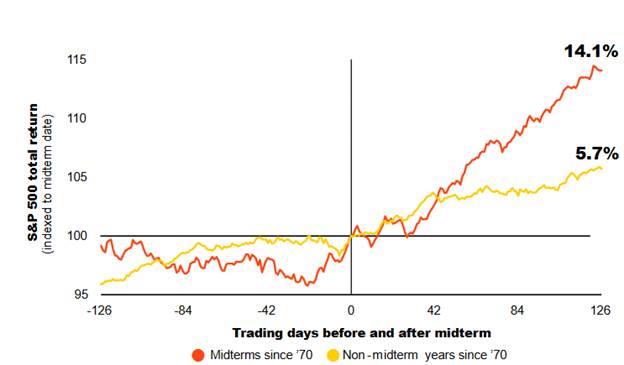
One possible explanation is that uncertainty surrounding congressional control, potential policy changes, and the regulatory environment can make it more difficult for businesses and investors to assess the outlook. Once the election is in the rearview mirror, some of that uncertainty begins to fade, and markets have historically delivered stronger returns over the following 12 months.7
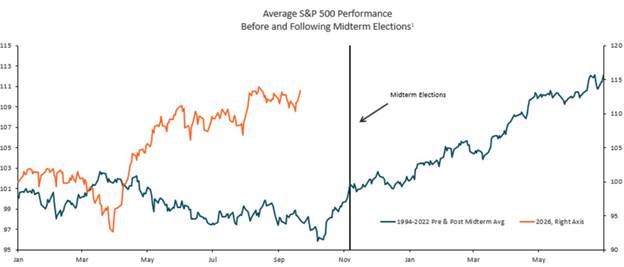
However, historical patterns are not guaranteed. This year has followed a different path, with markets performing relatively well ahead of the election and outperforming the typical midterm-year pattern.8 This divergence is a useful reminder that historical return patterns provide context for understanding market behavior, but they do not predict what happens next. Economic conditions, corporate earnings, interest rates, and other market drivers continue to influence performance.
Looking beyond the election itself, historical market performance has generally been positive across different combinations of congressional control as seen below.5 However, periods of divided government have often been particularly favorable for equity markets. When control of Washington is split, passing major legislation can become more difficult, potentially limiting large policy changes and reducing uncertainty around new regulations. For businesses and investors, a more predictable policy environment can be beneficial. Markets tend to favor stability, particularly when it allows companies to focus on operations, investment, and earnings growth rather than adapting to significant changes in the regulatory or tax landscape.
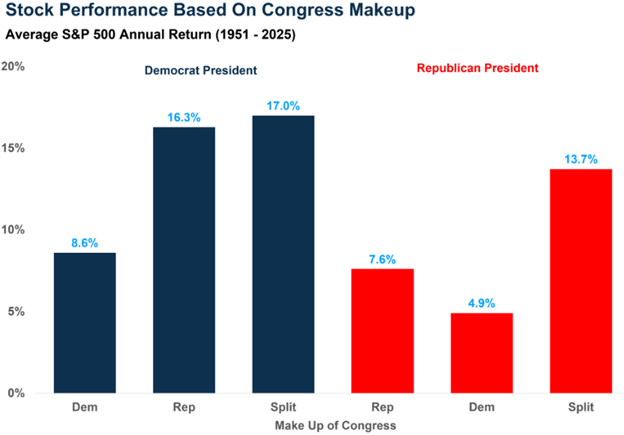
That said, gridlock is not automatically positive for markets. The effects depend on the policies at stake, the broader economic environment, and how investors interpret the implications for growth and corporate profitability. And while politics can influence markets in the short term, its longer-term impact is often more nuanced than headlines suggest. Businesses adapt to changing administrations and policy environments, while corporate earnings growth and the broader economy remain the most important drivers of equity markets.
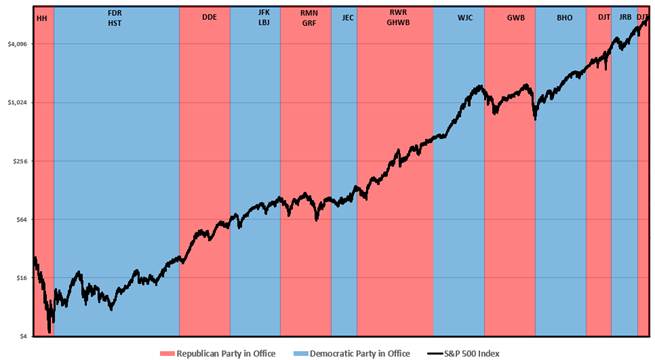
For investors, the takeaway is not to ignore elections, but to keep them in perspective. Midterms may create periods of uncertainty and volatility, but making portfolio decisions based primarily on political outcomes can mean reacting to headlines rather than fundamentals. The chart below9 shows that maintaining a disciplined, long-term investment approach remains more important than making investment decisions based on which party controls Congress.
1 https://ballotpedia.org/United_States_Congress_elections,_2026#resultsanalysis-ushouse-2
2 https://www.nbcnews.com/politics/2026-elections/midterms
3 https://kalshi.com/markets/controlh/house-winner/controlh-2026
4 https://polymarket.com/predictions/midterms
8 https://www.bny.com/wealth/global/en/insights/markets-and-midterms.html
9 Data sourced from St. Louis Fed, Yahoo Finance, and United States History Archive. Data range from January 2, 1930 to October 9, 2026
The information provided herein represents the opinions of the author and Gradient Investments as of the date of publication and is subject to change without notice. This commentary is for informational and educational purposes only and does not constitute personalized investment advice or a recommendation to buy, sell or hold any specific security, including the companies named above. Forward-looking statements, including statements about industry trends, pricing and demand, involve risks and uncertainties, and actual results may differ materially. Investing involves risk, including the possible loss of principal. Data cited from third-party sources is believed to be reliable but has not been independently verified by Gradient Investments.