
By TJ Klein, CFA®
The Federal Reserve (Fed), the central bank of the United States, is one of the most important factors affecting the economy, markets, and investors, as it controls the money supply and overnight interest rates (i.e., the fed funds rate). The Fed has two goals: maximum employment and stable prices. The fed funds rate is the rate at which banks lend excess cash reserves to one another overnight, and it serves as a benchmark that commercial lenders use to price consumer and business loans.
The Fed controls the money supply using assets on its balance sheet, which consist almost entirely of U.S. Treasuries and agency mortgage-backed securities. The fed funds rate is set by the Federal Open Market Committee (FOMC), which consists of the seven members of the Federal Reserve Board of Governors and five Regional Federal Reserve Bank presidents, totaling 12 voting members.
The leader (Chairman) of the Federal Reserve Board of Governors recently changed, and we are entering a new era for Federal Reserve leadership.
On May 22, 2026, Kevin Warsh was sworn in as Chairman of the Board of Governors, succeeding Jerome Powell, who had served as Chairman since 2018. The Chairman is widely viewed as the most powerful economic figure in the world, as their leadership strongly influences employment, inflation, and global financial stability.
Warsh stepped into his role and proposed changes to how the FOMC operates, including pulling back on forward guidance to allow more flexibility as data evolves and reducing FOMC press conferences from eight to six times per year to make each one more meaningful. He also created five “task forces” to potentially overhaul monetary policy.
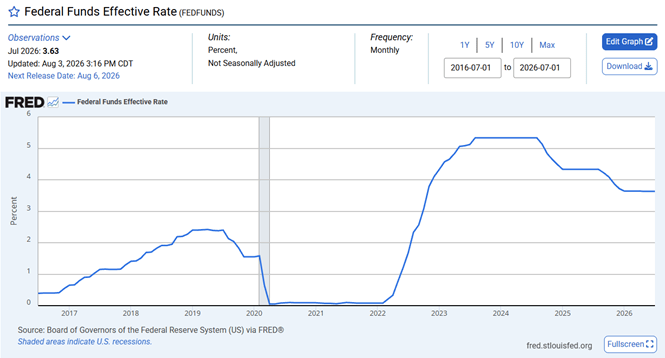
The chart below1 shows that the fed funds rate currently sits at 3.50%–3.75% and has seen significant volatility over the past four years. Post-pandemic, the fed funds rate sat at the “zero-bound” of 0%–0.25% before inflation took hold in 2021, causing the Fed to raise the fed funds rate significantly in 2022/2023 to 5.25%–5.50%.
As inflation cooled in 2023, the Fed began slowly reducing rates in 2024 and 2025, ending at 3.50%–3.75% in December 2025, where it’s remained on hold.
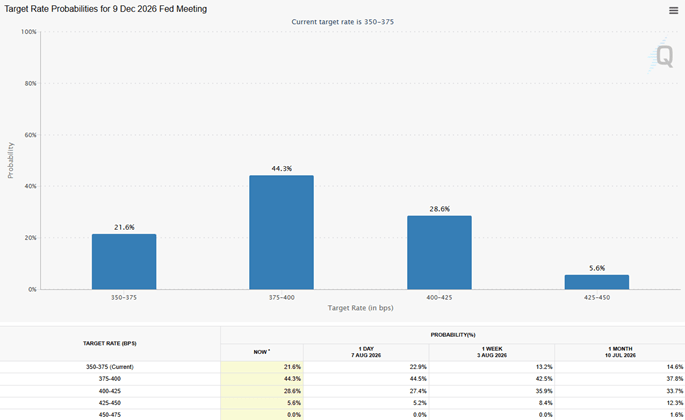
To start the year, the market was pricing in an expectation of two 25 bps rate cuts by year-end 2026. However, after inflation increased following the Iran conflict, the market has priced out rate cuts and now expects roughly two rate hikes by year-end as seen in the chart below.2
This demonstrates how quickly rate expectations can change and underscores the importance of following factors such as inflation and its underlying drivers. A rising fed funds rate can be a headwind for both stocks and bonds, as was clearly demonstrated throughout 2022.
As always, our investment team continues to pay close attention to the changes proposed by Warsh, the fed funds rate, and the primary drivers of that rate, including both inflation and employment. Inflation has taken on a larger focus in the near term as the Iran conflict continues to pressure energy prices while the unemployment rate remains healthy at 4.1%.
1 Fed Funds Rate
2 Fed Funds Rate Probabilities
The information provided herein represents the opinions of the author and Gradient Investments as of the date of publication and is subject to change without notice. This commentary is for informational and educational purposes only and does not constitute personalized investment advice or a recommendation to buy, sell or hold any specific security, including the companies named above. Forward-looking statements, including statements about industry trends, pricing and demand, involve risks and uncertainties, and actual results may differ materially. Investing involves risk, including the possible loss of principal. Data cited from third-party sources is believed to be reliable but has not been independently verified by Gradient Investments.