By Keith Gangl, CFA®
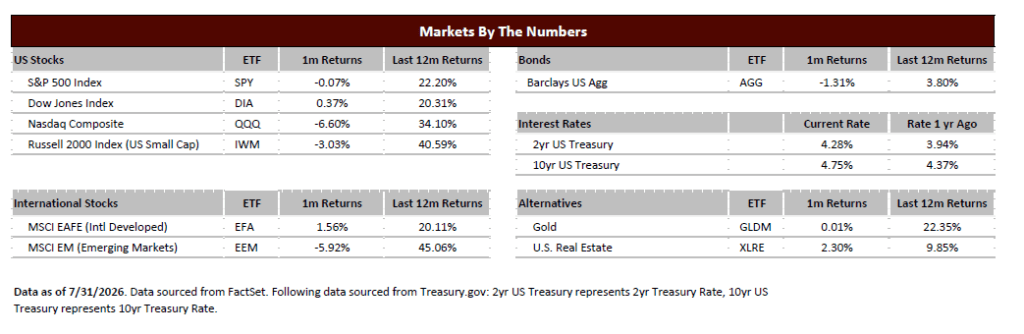
The S&P 500 was essentially flat in July, slipping just 0.07%, despite a month full of potential headline risk. Oil prices swung sharply on turmoil in the Middle East, second-quarter earnings came in strong but uneven across sectors, and the AI-driven semiconductor boom that had powered markets higher for months went into reverse. Yet through all of it, the broader market held its ground.
West Texas Intermediate (WTI) crude, the key benchmark for U.S. oil prices, rose more than 20%1 in July as the conflict between the U.S. and Iran escalated, at one point climbing over 30% above its end-of-June level. A sustained rise in oil prices is a headwind for the global economy: it adds to inflationary pressure and raises the risk of slower growth.
More than half of S&P 500 companies have now reported second-quarter results, and the numbers have been impressive, with aggregate earnings coming in 31%2 above analyst estimates. Over the long term, we believe corporate earnings are the primary engine of stock market returns, and markets tend to track the growth rate of those earnings.
A strong start to earnings season should be a tailwind for stocks going forward. Reactions among the so-called Magnificent Seven were mixed: Amazon (AMZN) and Microsoft (MSFT) were early winners following their reports, while Alphabet (GOOG), Meta Platforms (META) and Apple (AAPL) initially lagged, partly on concerns over rising capital expenditures as the AI infrastructure race intensifies.
Semiconductor stocks, represented by the Philadelphia Semiconductor Index (SOX), had led the market higher for much of 2026, gaining more than 100%3 over the first six months of the year. That trend reversed sharply in July, as the SOX dropped more than 20%4, its worst month since October 2008.
Rising AI-related capex has fueled strong demand for chips, and semiconductor companies’ earnings have largely reflected that strength. The pullback appears driven less by disappointing results than by investor uncertainty over whether the sector’s run of outsized earnings surprises is now behind it.
Taken together, July was a month that tested the market’s composure: a spike in oil prices, a sharp semiconductor correction and mixed reactions to megacap earnings all had the potential to knock stocks off course. The fact that the S&P 500 finished essentially unchanged speaks to the underlying strength of corporate earnings and the market’s ability to absorb sector-specific shocks without losing its footing.
Volatility beneath the surface remains elevated, and investors should expect more of it as the AI investment cycle matures and geopolitical risks persist. But for now, resilience, not disruption, remains the defining story of the market.